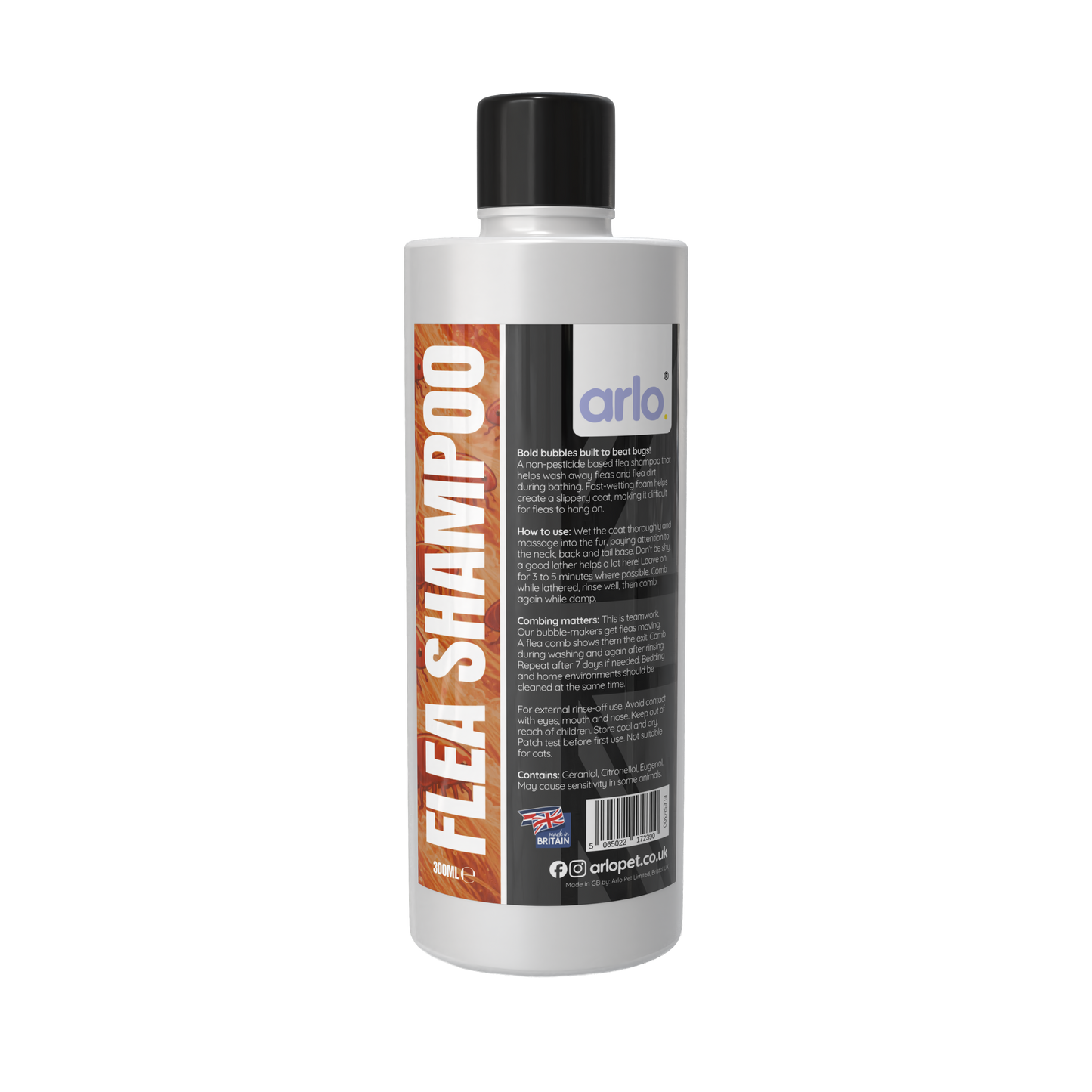
How to Use
How to Use
- Wet the coat thoroughly with warm water.
- Apply the Flea Shampoo generously throughout the coat.
- Massage deeply into the coat and down to the skin.
- Work into a rich foam, paying particular attention to areas where fleas and flea dirt may accumulate.
- Allow 3-5 minutes contact time to ensure thorough wetting of the coat.
- Rinse thoroughly.
- Use a flea comb to mechanically remove loosened fleas, flea dirt and debris.
- Repeat if required.
Top Tip: Keep a bowl of warm soapy water nearby when flea combing. Any fleas removed can be deposited directly into the water.
Thick Coat Tip: Work the shampoo thoroughly through dense coats to ensure complete wetting from skin to coat tip.
Remember: The shampoo helps loosen and lift. The flea comb completes the process.
Ingredients
Ingredients
Geraniol is one of the most widely recognised naturally derived ingredients used in products associated with flea season and outdoor animal care. It is particularly valued because fleas and other biting insects find environments containing geraniol far less appealing than untreated coats, making it a popular ingredient in flea-focused grooming products.
Eugenol, naturally found in clove oil, has long been associated with flea season grooming products. Alongside geraniol, it helps create a less attractive environment for fleas whilst supporting routine coat cleansing and grooming.
Geraniol and eugenol work particularly well together because both are widely recognised by pet owners as ingredients associated with flea season management. During bathing, they help create an environment fleas would rather avoid whilst the shampoo gets to work cleansing the coat.
Advanced wetting surfactants are one of the most important parts of the formula. Fleas are extremely good at hiding deep within thick coats where ordinary shampoos often struggle to penetrate. These specialised wetting agents help drive water and shampoo right through the coat, reaching the areas where fleas, flea dirt and debris commonly accumulate.
Rich foam technology helps lift flea dirt, grease, dried skin, debris and environmental contamination from the coat. As the coat becomes fully saturated, fleas often become easier to locate and remove.
Mechanical flea removal technology sits at the heart of the formula. The shampoo thoroughly wets the coat, helps create an environment fleas dislike, loosens flea dirt and debris, and supports the combing process. The shampoo gets the fleas moving. The flea comb shows them the door.
Customer Reviews
Customer Reviews
FAQ
FAQ
Why are fleas so difficult to get rid of?
Fleas spend much of their life cycle away from the dog. Whilst adult fleas may be visible within the coat, eggs, larvae and pupae can often be found in bedding, carpets, furniture and other areas of the home. This is why effective flea management often involves both the dog and its environment.
How do dogs get fleas?
Dogs commonly pick up fleas from outdoor environments, contact with other animals, kennels, bedding, wildlife areas and places previously visited by infested animals. Even dogs with limited outdoor exposure can encounter fleas.
Why does my dog keep getting fleas?
Recurring flea problems often occur because fleas are being reintroduced from the surrounding environment. Bedding, carpets, furniture, vehicles and outdoor resting areas can all play a role in ongoing flea activity.
What is flea dirt?
Flea dirt appears as small black specks within the coat and is often one of the first visible signs owners notice. It is commonly found around the neck, shoulders, tail base, belly and hindquarters.
How do I check my dog for fleas?
Regular grooming and flea combing remain some of the easiest ways to check for fleas. Pay particular attention to warm areas of the body such as the neck, belly, groin and tail base where flea activity is often noticed first.
Can one flea become an infestation?
Fleas reproduce remarkably quickly. This is one reason many owners take action as soon as flea activity or flea dirt is discovered.
Why does flea combing work better after bathing?
Fleas are excellent at hiding deep within the coat. Thorough bathing helps fully wet the coat, loosen flea dirt and debris, and can make fleas easier to locate and remove with a flea comb.
Why does this shampoo contain geraniol?
Geraniol is widely recognised as an ingredient associated with flea season grooming products. Fleas find environments containing geraniol far less appealing than untreated coats, making it a popular ingredient within flea-focused bathing routines.
Why does this shampoo contain eugenol?
Eugenol, naturally found in clove oil, has long been used in grooming products associated with flea season. Alongside geraniol, it helps create a less attractive environment for fleas whilst supporting the overall bathing and grooming process.
How do geraniol and eugenol help during flea season?
Both ingredients are widely recognised by pet owners as compounds associated with flea-focused grooming products. Combined with thorough washing and flea combing, they help support a complete grooming-led approach to flea management.
Can bathing help remove fleas?
Many owners use bathing as part of a mechanical flea removal programme. Thorough washing helps wet the coat, loosen flea dirt and make fleas easier to locate and remove during combing.
What is mechanical flea removal?
Mechanical flea removal focuses on physically washing, loosening and combing fleas and flea dirt from the coat rather than relying solely on pesticide-based approaches.
Why is rich foam important in a flea shampoo?
Rich foam helps surround flea dirt, grease, debris and contaminants throughout the coat, making them easier to lift and wash away during bathing.
Why are wetting agents important in a flea shampoo?
Fleas often hide deep within thick coats where ordinary shampoos may struggle to penetrate. Advanced wetting agents help drive water and shampoo further into the coat, improving coverage from skin to hair tip.
Can fleas hide in thick coats?
Yes. Dense, double-coated and long-haired breeds can provide excellent shelter for fleas, making thorough bathing and regular flea combing particularly important.
What is the best way to remove fleas from a thick-coated dog?
Many owners combine thorough bathing, deep coat wetting, rich cleansing foam and careful flea combing to help remove fleas and flea dirt from dense coats.
Why is my dog scratching but I can't see fleas?
Fleas can be surprisingly difficult to spot, particularly in dark, thick or dense coats. Flea dirt is often noticed before adult fleas are seen.
Why are fleas worse during summer?
Warmer temperatures can accelerate the flea life cycle, which is why many owners become more aware of flea activity throughout spring and summer.
Can dogs get fleas in winter?
Yes. Heated homes and indoor environments can allow flea populations to remain active throughout the year.
Should I use a flea comb after shampooing?
Absolutely. The shampoo helps loosen debris, fully wet the coat and create an environment fleas find less appealing. The flea comb then helps physically remove fleas and flea dirt. The shampoo gets the fleas moving. The flea comb shows them the door.
Can flea dirt stay in the coat after fleas are gone?
Yes. Flea dirt can remain trapped within the coat even after flea activity has reduced. Thorough washing and grooming help remove this debris.
Can I use Flea Shampoo regularly?
The pH-balanced formula has been developed with routine grooming and coat care in mind, making it suitable for regular bathing when required.
Why is pH balance important in dog shampoo?
Dogs have different skin requirements to humans. pH-balanced grooming products are designed to support routine skin and coat care whilst helping maintain coat condition.
What makes this Flea Shampoo different?
Rather than relying on pesticide-based action alone, our Flea Shampoo combines geraniol, eugenol, advanced wetting agents, rich cleansing foam and mechanical flea removal principles. It helps create an environment fleas dislike whilst supporting effective bathing and flea combing.
Who is Flea Shampoo designed for?
Flea Shampoo is designed for dog owners looking for a grooming-led, non-pesticidal approach to flea management, coat cleansing and flea dirt removal.
arlo.®
Flea Shampoo for Dogs
Flea Shampoo for Dogs
Couldn't load pickup availability
How to Use
How to Use
- Wet the coat thoroughly with warm water.
- Apply the Flea Shampoo generously throughout the coat.
- Massage deeply into the coat and down to the skin.
- Work into a rich foam, paying particular attention to areas where fleas and flea dirt may accumulate.
- Allow 3-5 minutes contact time to ensure thorough wetting of the coat.
- Rinse thoroughly.
- Use a flea comb to mechanically remove loosened fleas, flea dirt and debris.
- Repeat if required.
Top Tip: Keep a bowl of warm soapy water nearby when flea combing. Any fleas removed can be deposited directly into the water.
Thick Coat Tip: Work the shampoo thoroughly through dense coats to ensure complete wetting from skin to coat tip.
Remember: The shampoo helps loosen and lift. The flea comb completes the process.
Ingredients
Ingredients
Geraniol is one of the most widely recognised naturally derived ingredients used in products associated with flea season and outdoor animal care. It is particularly valued because fleas and other biting insects find environments containing geraniol far less appealing than untreated coats, making it a popular ingredient in flea-focused grooming products.
Eugenol, naturally found in clove oil, has long been associated with flea season grooming products. Alongside geraniol, it helps create a less attractive environment for fleas whilst supporting routine coat cleansing and grooming.
Geraniol and eugenol work particularly well together because both are widely recognised by pet owners as ingredients associated with flea season management. During bathing, they help create an environment fleas would rather avoid whilst the shampoo gets to work cleansing the coat.
Advanced wetting surfactants are one of the most important parts of the formula. Fleas are extremely good at hiding deep within thick coats where ordinary shampoos often struggle to penetrate. These specialised wetting agents help drive water and shampoo right through the coat, reaching the areas where fleas, flea dirt and debris commonly accumulate.
Rich foam technology helps lift flea dirt, grease, dried skin, debris and environmental contamination from the coat. As the coat becomes fully saturated, fleas often become easier to locate and remove.
Mechanical flea removal technology sits at the heart of the formula. The shampoo thoroughly wets the coat, helps create an environment fleas dislike, loosens flea dirt and debris, and supports the combing process. The shampoo gets the fleas moving. The flea comb shows them the door.
Customer Reviews
Customer Reviews
FAQ
FAQ
Why are fleas so difficult to get rid of?
Fleas spend much of their life cycle away from the dog. Whilst adult fleas may be visible within the coat, eggs, larvae and pupae can often be found in bedding, carpets, furniture and other areas of the home. This is why effective flea management often involves both the dog and its environment.
How do dogs get fleas?
Dogs commonly pick up fleas from outdoor environments, contact with other animals, kennels, bedding, wildlife areas and places previously visited by infested animals. Even dogs with limited outdoor exposure can encounter fleas.
Why does my dog keep getting fleas?
Recurring flea problems often occur because fleas are being reintroduced from the surrounding environment. Bedding, carpets, furniture, vehicles and outdoor resting areas can all play a role in ongoing flea activity.
What is flea dirt?
Flea dirt appears as small black specks within the coat and is often one of the first visible signs owners notice. It is commonly found around the neck, shoulders, tail base, belly and hindquarters.
How do I check my dog for fleas?
Regular grooming and flea combing remain some of the easiest ways to check for fleas. Pay particular attention to warm areas of the body such as the neck, belly, groin and tail base where flea activity is often noticed first.
Can one flea become an infestation?
Fleas reproduce remarkably quickly. This is one reason many owners take action as soon as flea activity or flea dirt is discovered.
Why does flea combing work better after bathing?
Fleas are excellent at hiding deep within the coat. Thorough bathing helps fully wet the coat, loosen flea dirt and debris, and can make fleas easier to locate and remove with a flea comb.
Why does this shampoo contain geraniol?
Geraniol is widely recognised as an ingredient associated with flea season grooming products. Fleas find environments containing geraniol far less appealing than untreated coats, making it a popular ingredient within flea-focused bathing routines.
Why does this shampoo contain eugenol?
Eugenol, naturally found in clove oil, has long been used in grooming products associated with flea season. Alongside geraniol, it helps create a less attractive environment for fleas whilst supporting the overall bathing and grooming process.
How do geraniol and eugenol help during flea season?
Both ingredients are widely recognised by pet owners as compounds associated with flea-focused grooming products. Combined with thorough washing and flea combing, they help support a complete grooming-led approach to flea management.
Can bathing help remove fleas?
Many owners use bathing as part of a mechanical flea removal programme. Thorough washing helps wet the coat, loosen flea dirt and make fleas easier to locate and remove during combing.
What is mechanical flea removal?
Mechanical flea removal focuses on physically washing, loosening and combing fleas and flea dirt from the coat rather than relying solely on pesticide-based approaches.
Why is rich foam important in a flea shampoo?
Rich foam helps surround flea dirt, grease, debris and contaminants throughout the coat, making them easier to lift and wash away during bathing.
Why are wetting agents important in a flea shampoo?
Fleas often hide deep within thick coats where ordinary shampoos may struggle to penetrate. Advanced wetting agents help drive water and shampoo further into the coat, improving coverage from skin to hair tip.
Can fleas hide in thick coats?
Yes. Dense, double-coated and long-haired breeds can provide excellent shelter for fleas, making thorough bathing and regular flea combing particularly important.
What is the best way to remove fleas from a thick-coated dog?
Many owners combine thorough bathing, deep coat wetting, rich cleansing foam and careful flea combing to help remove fleas and flea dirt from dense coats.
Why is my dog scratching but I can't see fleas?
Fleas can be surprisingly difficult to spot, particularly in dark, thick or dense coats. Flea dirt is often noticed before adult fleas are seen.
Why are fleas worse during summer?
Warmer temperatures can accelerate the flea life cycle, which is why many owners become more aware of flea activity throughout spring and summer.
Can dogs get fleas in winter?
Yes. Heated homes and indoor environments can allow flea populations to remain active throughout the year.
Should I use a flea comb after shampooing?
Absolutely. The shampoo helps loosen debris, fully wet the coat and create an environment fleas find less appealing. The flea comb then helps physically remove fleas and flea dirt. The shampoo gets the fleas moving. The flea comb shows them the door.
Can flea dirt stay in the coat after fleas are gone?
Yes. Flea dirt can remain trapped within the coat even after flea activity has reduced. Thorough washing and grooming help remove this debris.
Can I use Flea Shampoo regularly?
The pH-balanced formula has been developed with routine grooming and coat care in mind, making it suitable for regular bathing when required.
Why is pH balance important in dog shampoo?
Dogs have different skin requirements to humans. pH-balanced grooming products are designed to support routine skin and coat care whilst helping maintain coat condition.
What makes this Flea Shampoo different?
Rather than relying on pesticide-based action alone, our Flea Shampoo combines geraniol, eugenol, advanced wetting agents, rich cleansing foam and mechanical flea removal principles. It helps create an environment fleas dislike whilst supporting effective bathing and flea combing.
Who is Flea Shampoo designed for?
Flea Shampoo is designed for dog owners looking for a grooming-led, non-pesticidal approach to flea management, coat cleansing and flea dirt removal.
Flea Shampoo for Dogs is a deep-cleansing dog shampoo developed to support the mechanical removal of fleas, flea dirt and debris from the coat during bathing. Combining powerful wetting agents, rich cleansing foam and naturally derived aromatic compounds including geraniol and eugenol, the formula helps thoroughly wet the coat, loosen dirt and encourage effective flea removal.
Unlike pesticide-based flea treatments, our Flea Shampoo works through cleansing, wetting and mechanical removal. The rich foam penetrates deep into the coat, helping lift flea dirt, grease, debris and contaminants whilst encouraging fleas to move within the coat where they can be more easily removed during washing and combing.
The formula has been specifically developed to spread quickly through thick, dense and difficult coats. Powerful wetting bubbles help water reach the skin and coat more effectively, ensuring the shampoo works throughout the entire coat rather than simply sitting on the surface.
Many dog owners discover fleas after noticing increased scratching, nibbling, irritation or the presence of flea dirt within the coat. Flea dirt, which appears as small black specks, is often one of the first visible signs that fleas may be present.
During bathing, the rich foam helps loosen dirt, grease and debris whilst supporting thorough coat cleansing. Following shampooing, many owners use a flea comb to help physically remove fleas, flea dirt and other debris from the coat. Put simply, the shampoo gets the fleas moving and the flea comb shows them the door.
The pH-balanced formula has been developed with routine skin and coat care in mind, making it suitable for regular grooming use during periods when additional coat cleansing may be required.
Flea Shampoo is particularly popular during warmer months when flea activity often increases, but can be used throughout the year as part of a wider grooming and coat-care routine.
Whether you're tackling flea dirt, dealing with an itchy dog or carrying out routine coat maintenance, Flea Shampoo provides a practical, non-pesticidal approach to supporting flea management through bathing and mechanical removal.
Share